About Guillermo Forchino, Argentine sculptor working in Paris
In the mid-1980s Paris became his adopted city, ‘a theatrical city, one vast stage set’. Yet Rosario has never left him. ‘Everything I do is intimately bound up with the places of my youth,’ he says. ‘I consider myself an artist from Rosario. I see my figures as Rosarinos, above all in their attitudes and expressions.’
His artistic vision is born of the encounter between these two worlds: the city of his birth and the city that took him in.
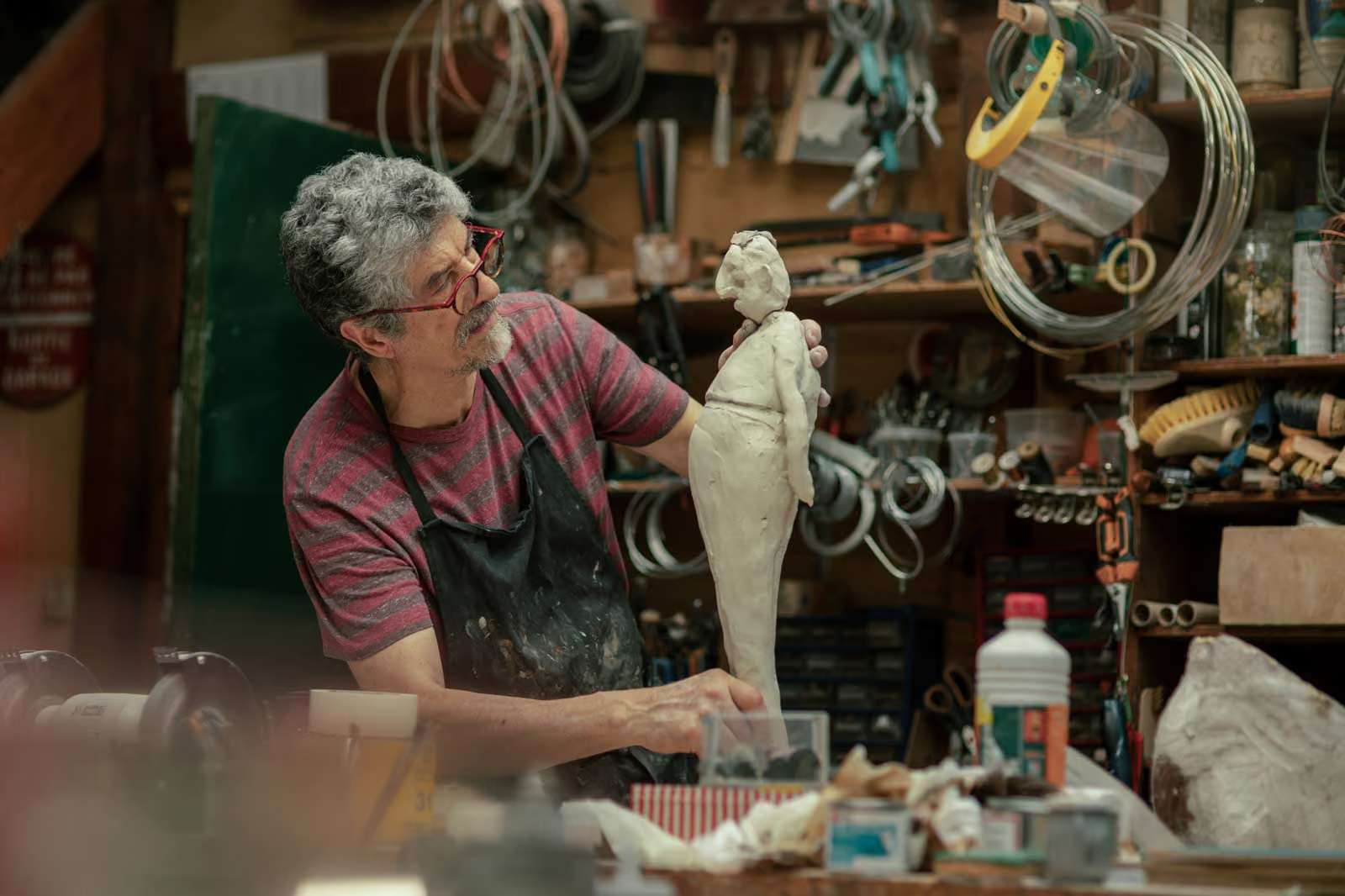
Guillermo Forchino draws on a remarkable diversity of materials in his work. In his early years he worked with interwoven strips of canvas, papier-mâché, natural pigments and wax; later he introduced resins and various types of silicone and, more recently, bronze. His training as an art restorer gave him a deep understanding of historical techniques and traditional materials, and led him to discover Il libro dell’arte by Cennino Cennini, the Renaissance treatise he read ‘as if it were a novel’. Nothing in his studio is thrown away; everything is treasured. A multitude of faces, figures and objects lie in wait for the work that will give them a home.
1980s — Desafinados. Visits to psychiatric hospitals around Rosario give rise to his first figures: canvas bodies and papier-mâché faces, finished in natural pigments and beeswax. Tender yet tormented, they speak for those society keeps out of sight.
1990s — Comœdia Mundi. Pouring resin into silicone moulds opens a new dimension, and irony comes to the fore. Everyday life becomes theatre: richly detailed scenes that first bring a smile, then invite reflection.
2000s – 2010s — La mirada negada. Old age, illness, the end of life, the disappeared of the dictatorship. In 2010, Falcon verde entered the permanent collection of the Haroldo Conti Cultural Center for Memory in Buenos Aires.
Today — Me ne frego and Ajustes. Bathers lounging amid ecological collapse; a chainsaw taken to a wheelchair, a first-aid box, a school desk. The irony turns biting. The gaze stays tender.
Chronology
Guillermo Forchino is born in Rosario into a family that encourages his artistic calling from childhood. He studies Fine Arts at the National University of Rosario and later receives a scholarship from the French Ministry of Foreign Affairs to train in the restoration and conservation of works of art at the University of Paris 1 Panthéon-Sorbonne.
He returns to Argentina, where he founds and heads the first restoration and conservation department at the Juan B. Castagnino Museum of Fine Arts. Against the backdrop of the return to democracy and a period of intense cultural ferment, he takes part in the group exhibition Desafinados (1985), which draws considerable interest for the expressive power of the works and the sensitivity of its approach.
In October 1985 he settles permanently in Paris to devote himself fully to sculpture. Two years later, the art critic Pierre Restany awards him first prize for sculpture for his work HLM, at an exhibition held at the Espace latino-américain.
He embarks on Comœdia Mundi, a series exploring the contradictions of existence through everyday scenes, expressive characters and situations that hover between humor and the absurd. In 1995 a selection of these works is shown in Argentina for the first time, at the Centro Cultural Recoleta in Buenos Aires. The series is still growing and now comprises some 150 pieces.
In the early 2000s his Desafinados series reaches a wider audience with the group exhibition ‘Desafinados II’, shown in Rosario and Buenos Aires, and the solo exhibition ‘En Ton Noir’ in Noyers-sur-Serein, France.
Always keen to explore new materials, he trains in silicone painting techniques with a specialist in A Coruña, Spain.
He launches Me ne frego, an ongoing series that Forchino continues to expand with new works on environmental degradation, a reality that concerns us all.
He creates La mirada negada, shown in a group exhibition at the Fundación OSDE in Rosario – a reflection on willful blindness and the realities that society and those in power prefer to ignore or conceal.
At a time marked by budget cuts and the dismantling of public structures, he begins the series Ajustes, which turns the spotlight on the impact of these policies on collective rights and well-being.
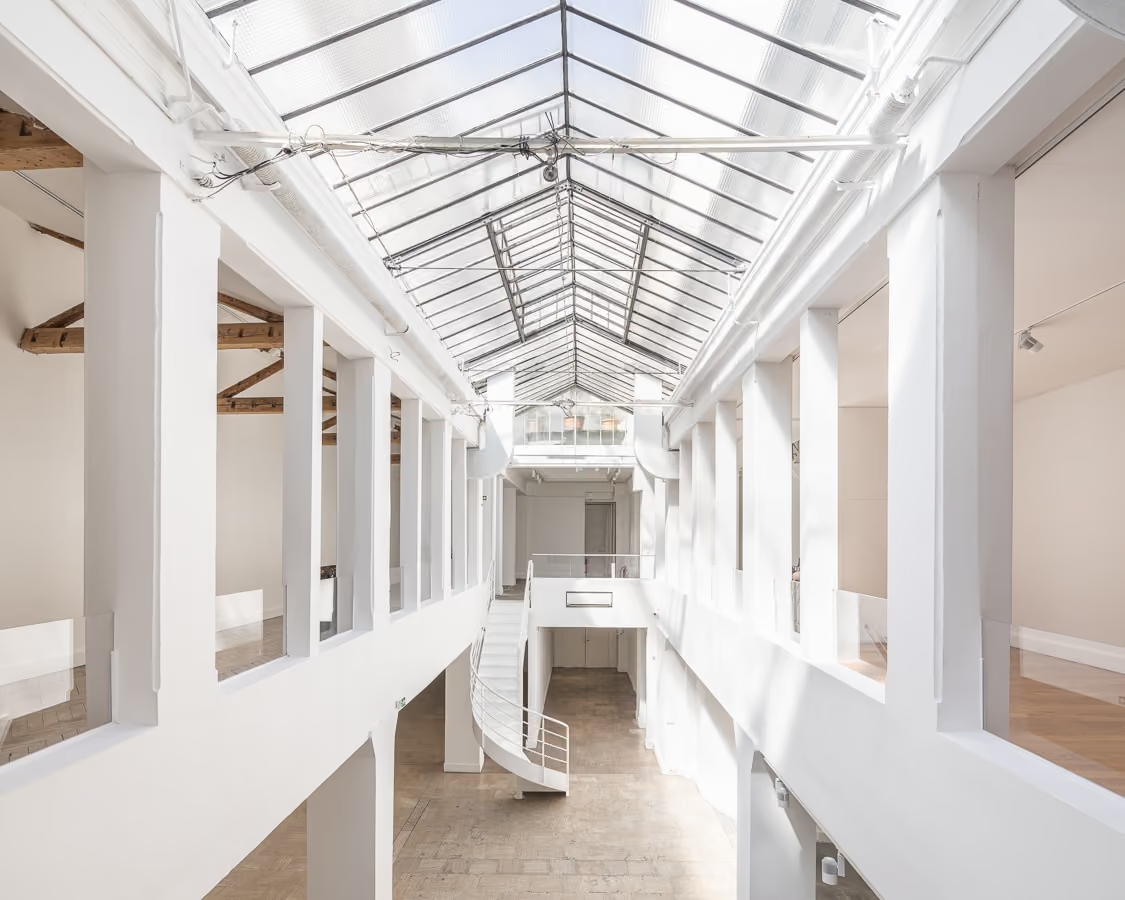
Paris hosts ‘Noi, i grotteschi’, Guillermo Forchino’s first major retrospective, tracing his career from the 1980s to the present day and including works never exhibited before.
Somewhere between observation and imagination, Forchino builds a world of his own, peopled with characters and scenes that capture, with humor and irony, the complexity and contradictions of the human experience.